
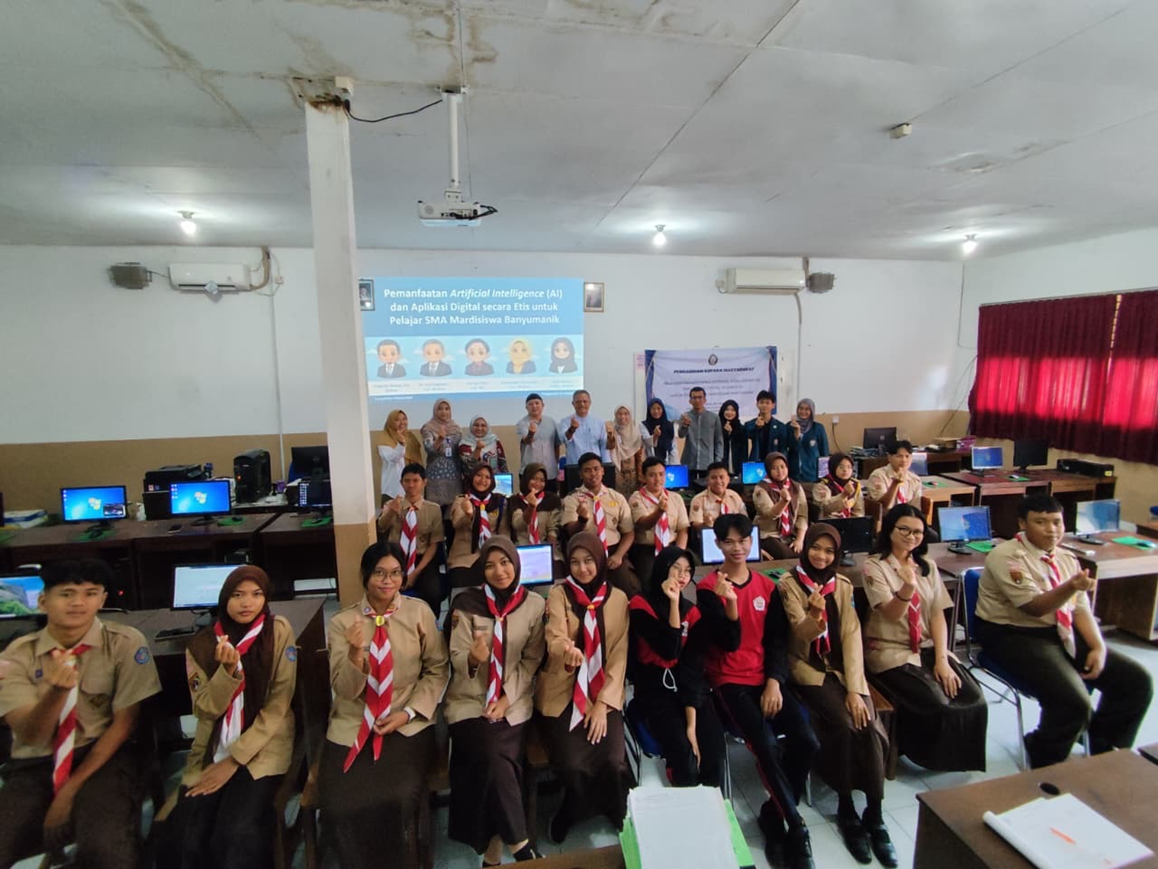
Semarang – The community service team of the Department of Informatics, Faculty of Science and Mathematics, Universitas Diponegoro held an activity “training on the use of Artificial Intelligence (AI) and digital applications ethically for students of SMA Mardisiswa Banyumanik.” This activity is carried out as a form of contribution from universities in improving digital literacy of students in the midst of the wider use of Artificial Intelligence technology in everyday life, especially in the learning process.
The development of AI provides various conveniences for students, ranging from helping to find information, understand learning materials, compile summaries, to supporting creativity. However, the use of such technology also needs to be accompanied by an understanding of the limitations and responsibilities of its use. The use of AI without an adequate ethical understanding can lead to various problems, such as plagiarism, dependence on technology, dissemination of inaccurate information, and risks to the security and privacy of personal data.
Through this training, the students of SMA Mardisiswa Banyumanik Semarang gained an introduction to the basic concepts of Artificial Intelligence and examples of its application in everyday life and in education. Participants were also introduced to the various benefits of AI as a learning aid, including to obtain information quickly, help understand the material, and support creativity in producing various forms of digital work. The material also emphasizes that AI should be placed as a tool in the learning process, not as a substitute for the student’s thinking process.
The ethical aspect is one of the main parts of the training. Students are invited to understand the importance of academic honesty when using AI to do schoolwork. Participants are also given an understanding of the risk of plagiarism and the responsibility of users in ensuring that the use of technology remains in accordance with academic values and applicable norms.
In addition to the ethics of using AI, the training addresses digital security and Privacy. Students are introduced to the concepts of personal data and digital footprint and the importance of being careful when entering information into digital applications or services. This understanding is important because the use of various digital platforms and AI-based technologies can involve the collection and processing of user information.
Critical thinking skills are also a concern in this activity. Students are encouraged not to immediately accept any information obtained from AI or the internet as true information. They are directed to verify sources, compare information, and recognize the possibility of inaccurate or hoax information. This approach is expected to help students become more critical and responsible users of technology.
The implementation of the training uses an educational and interactive approach through the presentation of materials, discussions, questions and answers, as well as discussion of case studies on the use of AI in the school environment. The learning Model is designed so that learners not only understand concepts theoretically, but can also relate them to their experiences when using AI and digital applications in everyday life. The participatory approach is in accordance with the method of activities designed in the service program.
Through this activity, the community service team of the Department of Informatics FSM Universitas Diponegoro hopes that Mardisiswa Banyumanik high school students will be able to utilize AI and digital applications intelligently, safely, productively, ethically, and responsibly. AI literacy accompanied by awareness of ethics and digital security is expected to support the learning process as well as forming the character of students who are ready to face technological developments in the digital era.