
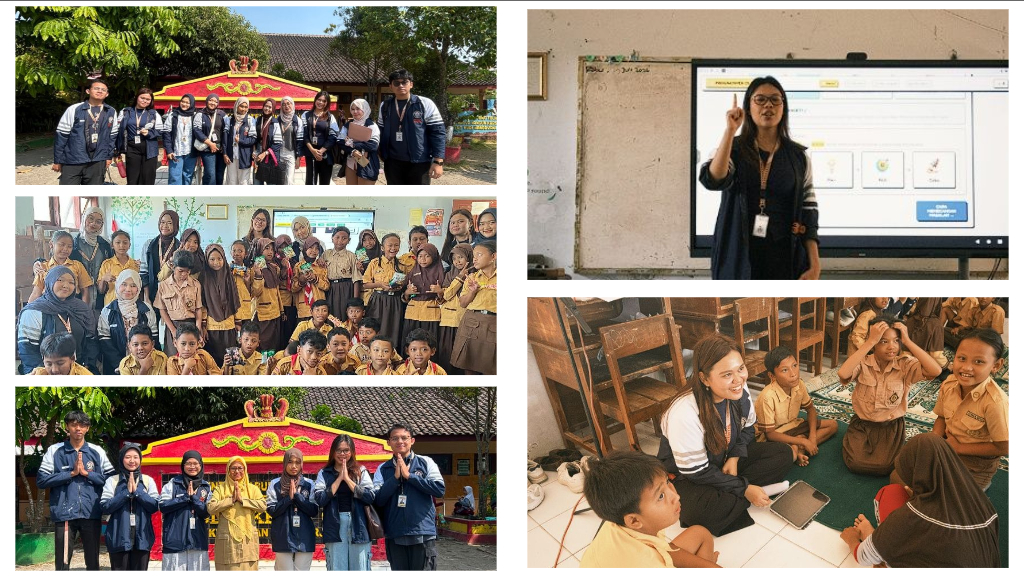
Sukoharjo, July 31, 2026 – The student team of the thematic real work lecture on Village innovation and sustainable empowerment (KKNT IDBU) 64 of Universitas Diponegoro (UNDIP) successfully carried out an introduction to computational thinking through a program entitled “little PROGRAMMER”. This interactive activity is intended for 29 students of Grade 5 of SDN Kenep 03, Kenep Village, Sukoharjo district, Sukoharjo regency, on Friday (31/7/2026). This collaborative Program that combines the expertise of students from the Informatics, Communication Sciences, and Information and Public Relations study programs aims to hone students ‘ logical, critical, and systematic thinking skills from an early age. The implementation of this educational activity is also a form of real support for the achievement of the Sustainable Development Goals (SDGs), especially SDG 4 on quality education through the use of adaptive technology-based learning media.
This Program was initiated based on observations of learning challenges in the digital era, where problem solving skills (problem solving) is one of the main foundations that must be owned by the younger generation. In rural areas such as Kenep Village, the potential of elementary school children in absorbing technology is very large, but access to computational thinking learning methods is still limited. During this time, programming concepts were often considered complicated and only related to computers. In fact, the essence of computational thinking includes solving complex problems into smaller, simpler parts, recognizing patterns, as well as arranging logical problem-solving flows. This urgency is what drives the IDBU 64 UNDIP KKNT team to present a fun learning approach so that students ‘ thinking logic can be honed without feeling burdened with heavy technical material.
Answering these problems, students launched an integrated solution through a series of programs “PROGRAMMER CILIK” that combines web-based technology, visual media, and information documentation. Informatics students develop interactive web Learning media that contains an introduction to concepts and educational games such as Logic, stacking steps, and mazes. Meanwhile, Communication Science students design visually attractive educational posters to facilitate understanding of concepts in a structured manner, and Information and Public Relations students document the entire process for the purposes of publication and educational archives. In its implementation, students are invited to actively make choices, draw up step-by-step instructions, and find ways out of game challenges, which directly implement the indicators for improving the quality of education in SDG 4.
The active involvement of all parties is the key to the successful implementation of this program at SDN Kenep 03. The students seemed enthusiastic about trying challenges on interactive media, discussing with each other to determine the best strategy, and were not afraid to try again when they found a mistake in the game. The school warmly welcomes this activity. Nuur Hayati, S.Pd. M.Pd., as the principal of SDN Kenep 03, expressed his deep appreciation for the concern of UNDIP students for the education of children in their schools. “Hopefully the material presented can be well received by children and provide real benefits for the development of their thinking. We are very grateful, hopefully this activity will be a kindness and blessing for younger students who have shared their knowledge in our school,” he said when giving a speech.
This service activity has a positive impact and concrete outcomes for school development. The main results obtained include the availability of web Learning media” PROGRAMMER CILIK ” ready to use, educational posters as informative displays in the classroom, as well as recording documentation of activities. Web-based learning media can be accessed through small PROGRAMMER https://bit.ly/Sosmas-Computational-Thinking. the immediate benefit felt by the students was increased confidence in systematically analyzing simple problems. Moreover, the output of this program comes as a supporting learning module that can be accessed again by teachers and students, thus creating a long-term impact in strengthening digital literacy and 21st century skills for students in the Kenep Village area.
The existence of this learning platform and media is expected not to stop when the KKN-T period ends, but can continue to be used continuously by the school as an alternative to interactive learning methods. The follow-up plan includes handing over access to learning media to the teacher so that the introduction to computational thinking can be integrated periodically. This multidisciplinary collaboration proves that the synergy between technology development, public communication, and education is able to make a real contribution to the SDG 4 target (Quality Education). Through collaboration between universities, schools, and communities, this activity is expected to provide sustainable benefits and support the achievement of Sustainable Development Goals (SDGs). This spirit is in line with the commitment of “UNDIP dignified, Undip beneficial” in presenting services that have a real impact on the community.