
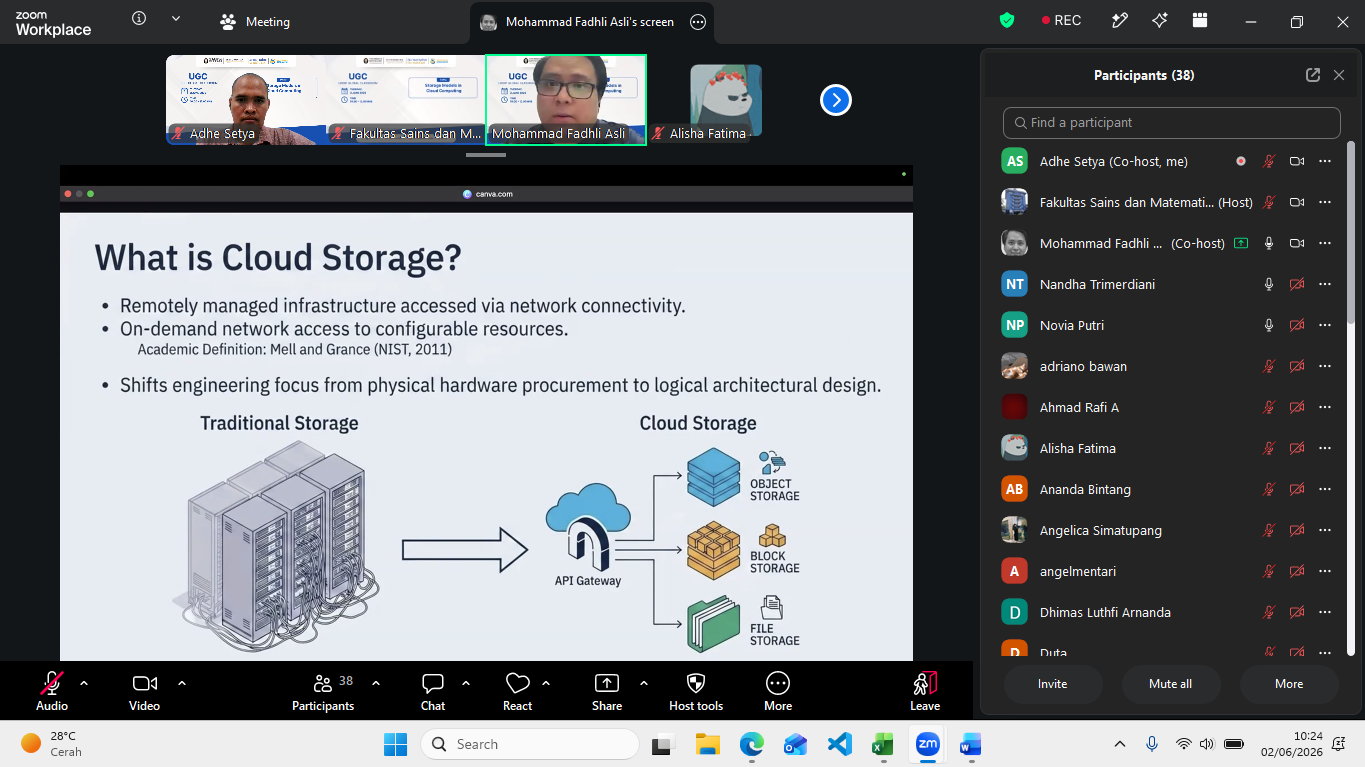
Semarang, June 2026. The Department of Informatics, Faculty of Science and Mathematics, Universitas Diponegoro, once again organized the UNDIP Global Classroom (UGC) program as part of its commitment to providing students with broader, more collaborative, and globally oriented learning experiences.
The activity was held as part of the 3-credit Cloud Computing course and was attended by 80 students. This UGC session was moderated by Adhe Setya Pramayoga, M.T. and featured an international expert, Mohammad Fadhli Asli, Ph.D. from Universiti Malaysia Sabah. The guest lecture was conducted twice online through the Zoom platform, on June 2, 2026 with the topic “Storage Models in Cloud Computing” and on June 3, 2026 with the topic “Database as a Service (DBaaS)”.
In the first session, Dr. Fadhli discussed the importance of choosing the right data storage model in cloud computing architecture. He explained that each application has different storage requirements, meaning that cloud storage solutions cannot be applied uniformly to all cases. Applications such as social media platforms, streaming services, online banking systems, and learning management systems have different data characteristics, performance needs, and scalability challenges.
Through the topic “Storage Models in Cloud Computing”, Dr. Fadhli introduced three primary cloud storage models: object storage, block storage, and file storage. Object storage was explained as a suitable model for unstructured data, such as media assets, AI datasets, and backups, due to its high scalability and API-based accessibility. Block storage was described as a better fit for applications that require high performance and low latency, such as database transactions and banking systems. Meanwhile, file storage was presented as an appropriate solution for data organized in folders and directories, such as collaborative documents, institutional repositories, and file-sharing systems.
Dr. Fadhli also emphasized that designing cloud storage is not only about storage capacity. Students were encouraged to consider key aspects such as cost, performance, availability, durability, security, and compliance. During the session, students were also introduced to storage tiers and lifecycle management, including how data can be moved from hot storage to cool storage and archive storage based on access patterns and cost-efficiency requirements.
In the second session, the discussion continued with the topic “Database as a Service (DBaaS)”. Dr. Fadhli explained that DBaaS is a cloud service that provides database functionality while simplifying various administrative tasks, such as provisioning, patching, backup, scaling, monitoring, and availability management. With DBaaS, users can focus more on application development, database design, queries, schemas, data, and access control, while cloud service providers handle the operational aspects of database management.
In addition to explaining the basic concept of DBaaS, Dr. Fadhli also discussed the differences between relational and NoSQL databases. Relational databases were introduced as a strong option for systems that require high consistency, ACID transactions, and well-defined data structures, such as banking systems and ERP platforms. On the other hand, NoSQL databases were presented as a more flexible option for large-scale applications, semi-structured or unstructured data, and horizontal scalability needs, such as social media, IoT, and real-time systems.
The activity was interactive and engaging. Students did not only listen to the material, but were also involved in case-based discussions and short quizzes using the Mentimeter application. Through these quizzes, students’ understanding of the material was assessed directly while encouraging them to participate more actively in the lecture. Several scenarios were discussed, including selecting the right storage model for social media platforms, digital banking systems, university repositories, and designing DBaaS architecture for e-commerce applications and hospital information systems.
The interaction with Dr. Fadhli provided students with a valuable learning experience. Through this activity, students gained a clearer understanding of how cloud storage and managed database technologies are applied in modern application development. They also learned that decisions in designing cloud architecture are not merely technical, but are closely related to cost efficiency, security, performance, scalability, and the ability of systems to adapt to evolving user needs.
The implementation of UGC in the Cloud Computing course reflects the commitment of the Department of Informatics, Faculty of Science and Mathematics, Universitas Diponegoro, to delivering learning experiences that are relevant to global technological developments. Through collaboration with international experts, students are expected to be better prepared to face the challenges of digital transformation and to design cloud-based solutions that are reliable, efficient, and aligned with the needs of modern industry.