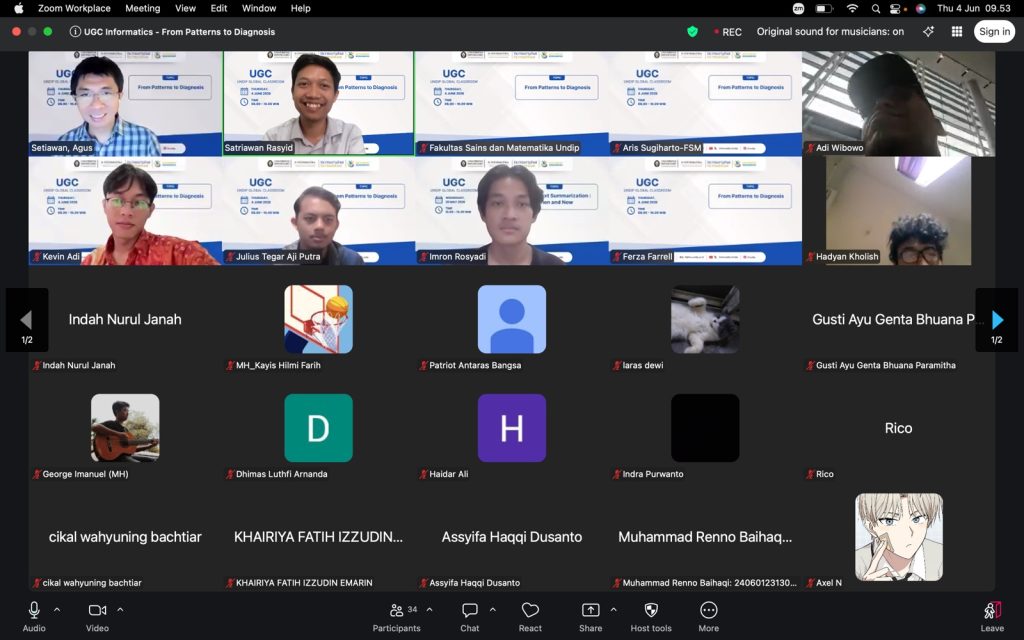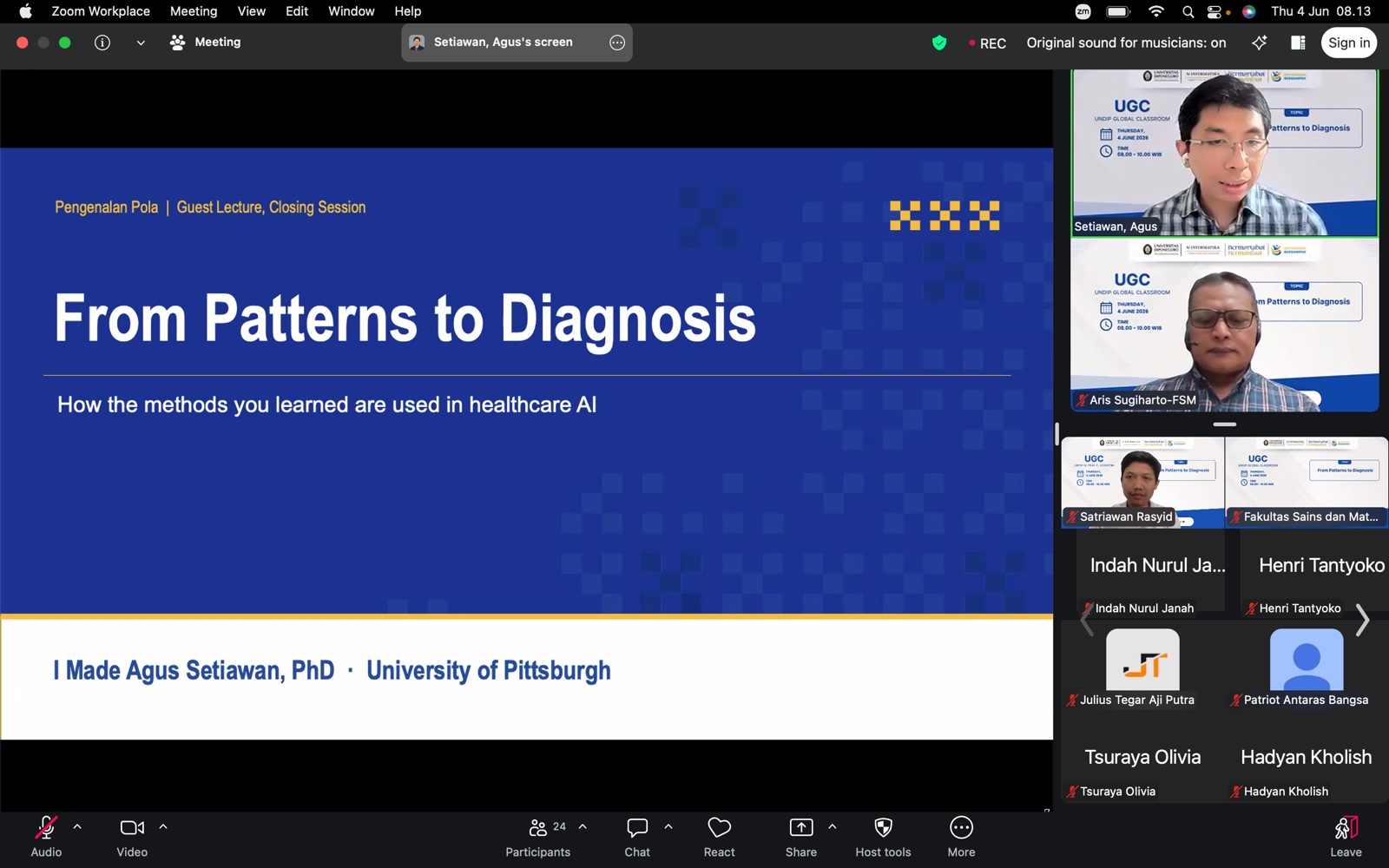
The Undip Global Classroom (UGC) was once again organized by the Department of Informatics, Faculty of Science and Mathematics, Universitas Diponegoro. On this occasion, the UGC carried the topic “From Patterns to Diagnosis” and was held on Thursday, 4 June 2026, from 08.00 to 10.00 WIB online via Zoom Meeting.
This event featured I Made Agus Setiawan, Ph.D. from the University of Pittsburgh, Pennsylvania, USA as the speaker, Satriawan Rasyid P., S.Kom., M.Cs. from the Department of Informatics, Faculty of Science and Mathematics, Universitas Diponegoro as the moderator, and was officially opened by Dr. Aris Sugiharto, S.Si., M.Kom., Head of the Department of Informatics. The topic discussed was highly relevant to the development of artificial intelligence, particularly in the field of pattern recognition and its application in the medical domain.
In his presentation, the speaker explained that pattern recognition is essentially a process of identifying regularities, structures, or specific characteristics within data. The analyzed data may take the form of numbers, text, signals, images, or a combination of various data types. In the medical context, pattern recognition can be used to help understand patient symptoms, interpret patterns in medical images, identify anomalies, and support the disease diagnosis process.
Pattern recognition is not merely about building a model that can predict a class. It also includes the entire process, starting from data collection, domain understanding, data cleaning, feature extraction, model selection, training, evaluation, and result interpretation. In other words, an artificial intelligence model does not stand alone; rather, it depends on the quality of the data and the correctness of the analytical stages performed beforehand.
The presentation also discussed the development of approaches in pattern recognition, ranging from the use of handcrafted features to modern generative models. In earlier approaches, researchers or practitioners typically designed features manually based on domain knowledge. For example, in medical images, features may include shape, texture, edges, pixel intensity, or the size of certain objects. This approach depends heavily on human expertise in determining which features are considered important.
With the advancement of machine learning and deep learning, feature extraction has increasingly been performed automatically by models. A Convolutional Neural Network (CNN), for instance, is capable of learning visual patterns from images hierarchically, starting from simple features such as lines and edges to more complex patterns. Further developments have led to larger and more flexible models, including generative models, which are not only capable of recognizing patterns but also of constructing data representations, generating synthetic data, supporting data augmentation, and enabling various forms of advanced analysis.
However, the speaker emphasized that the application of AI in the medical domain presents challenges and consequences that are far greater than those in many other domains. Prediction errors in medical systems do not only affect model evaluation scores, but may also influence clinical decisions, patient safety, examination costs, and follow-up treatment. For example, a false negative error may cause a patient who actually shows indications of disease to remain undetected, while a false positive may lead a patient to undergo unnecessary additional examinations.
Therefore, model selection in the medical field cannot rely solely on accuracy. Metrics such as recall, sensitivity, specificity, precision, F1-score, and balanced accuracy need to be considered according to the clinical objective. In many disease detection cases, the ability of a model to identify patients who are truly ill is highly important, making the evaluation of false negatives particularly critical.
In addition to discussing models, this activity also emphasized the importance of data cleanin. This stage is often considered simple and less attractive, although in real-world practice it is one of the most important parts of the pattern recognition pipeline. Medical data often contain missing values, invalid values, duplicates, inconsistent formats, incomplete records, and extreme values that require further analysis.
The speaker emphasized that model quality strongly depends on the quality of the data used. If the data entering the model are still problematic, the resulting predictions may also be incorrect. The principle of garbage in, garbage out is highly relevant in this context. Even a complex model will not produce reliable decisions if the data used have not been properly cleaned and understood.
Another important question discussed in this activity was whether AI can be directly used to solve medical problems. The answer is not that simple. AI cannot be used merely by feeding data into a model without understanding the problem context, data quality, patient characteristics, class distribution, risk of error, and the intended purpose of the model. AI must go through validation, evaluation, interpretation, and supervision processes to ensure that it is used responsibly.
In the educational context, this activity provided students with the insight that pattern recognition is not only about running algorithms, but also about understanding the problem, designing an appropriate pipeline, selecting relevant features, cleaning data, critically evaluating models, and considering the impact of prediction results. Students were also encouraged to understand that the use of AI, particularly in the medical field, must be carried out carefully because it is associated with decisions that have high consequences.
Through this UGC activity, students of the Department of Informatics are expected to gain a broader understanding of the progression of pattern recognition from fundamental concepts to its application in medical diagnosis. This topic also opened a space for discussion on how AI technology can be developed to be more accurate, safe, and responsible, particularly in the healthcare sector.
This Undip Global Classroom activity is expected to continue serving as a platform for expanding students’ academic perspectives, strengthening international networks, and introducing recent developments in research and technology that are relevant to scientific advancement and societal needs.